The 5 Best West Virginia Mountaineers in NFL History
West Virginia football has produced some of the most electrifying players in the history of the sport, and Morgantown remains one of the toughest places to play in the country. These five Mountaineers are ranked by their college careers.
1. Pat White
Quarterback · 2005 to 2008
Pat White won four bowl games as West Virginia's starting quarterback, including the Sugar Bowl against Georgia and the Fiesta Bowl against Oklahoma. He also established the NCAA career rushing-yardage record for a quarterback at the time. His college résumé therefore combines repeated postseason success with a major statistical accomplishment tied directly to the way he contributed at his position.
White's place in West Virginia's ranking is supported by breadth rather than one isolated season. The bowl victories offer multiple examples of team success with him starting, while the rushing record gives his individual production historical significance. His running belongs within the evaluation of his quarterback play. Together, those achievements create a sustained college-career case that does not depend on a later professional reputation.
2. Steve Slaton
Running Back · 2005 to 2007
Steve Slaton rushed for more than 1,700 yards in 2006 and scored 50 total touchdowns across three seasons at West Virginia. His speed was an important element alongside Pat White in Rich Rodriguez's spread offense. The rushing season supplies a distinct individual high point, while his career touchdown total shows that his scoring contribution extended beyond that single year.
Slaton's ranking argument benefits from keeping those two measures separate. His peak rushing output establishes the scale of one standout season; his total touchdowns demonstrate broader production without suggesting that every score came on the ground. Playing alongside White provides offensive context, but Slaton's own accomplishments merit attention. For West Virginia, he represents a running back whose individual output adds substance to the memory of a productive offense.
3. Tavon Austin
Wide Receiver · 2009 to 2012
Tavon Austin accumulated more than 2,900 all-purpose yards for West Virginia in 2012, including a 572-yard performance against Oklahoma. Those totals describe a contribution broader than receiving yardage alone, even though his position was wide receiver. He became a top-10 draft pick in 2013, following a college season with both substantial overall production and an exceptional individual-game highlight.
Austin's ranking case is strongest when the full season and the Oklahoma performance are kept in perspective. The game illustrates the scale of his peak, but the season total shows that his contribution was not limited to one afternoon. All-purpose production also warrants a different reading from a conventional receiving résumé. West Virginia's case for him rests on that wide-ranging college impact, with the draft transition remaining secondary.
4. Major Harris
Quarterback · 1987 to 1989
Major Harris led West Virginia to an 11–0 regular season in 1988 and a place in the national title game. He followed that team achievement by finishing third in the Heisman Trophy voting in 1989. Those consecutive seasons give his quarterback résumé two distinct points of emphasis: a championship opportunity for the Mountaineers and prominent individual recognition the following year.
Harris' ranking argument does not require merging those achievements into one season. The unbeaten regular season establishes the team success associated with his leadership at quarterback, while the later Heisman finish adds a separate measure of national standing. Together, they provide more depth than a single highlight or isolated award. His importance to West Virginia is grounded in both the program's title pursuit and his sustained prominence across that stretch.
5. Sam Huff
Linebacker · 1952 to 1955
Sam Huff earned All-America recognition as a lineman at West Virginia before becoming a Hall of Fame middle linebacker in professional football. His later career included the Giants and Washington, but his college contribution came in a different role. Keeping that distinction clear gives the Morgantown portion of his story its proper place rather than projecting his NFL position backward.
Huff's West Virginia ranking case begins with the national recognition he earned there. The All-America honor provides a concrete college accomplishment, while his Hall of Fame career explains the broader professional significance of his inclusion. This is not a case built around a supplied statistical peak or lengthy list of college awards. It rests on recognized line play at West Virginia, followed by distinguished achievement at another position.
Who Just Missed the Cut
Geno Smith, Stedman Bailey, Bruce Irvin, Owen Schmitt, Darryl Talley, and Kevin Kolb were considered. Smith threw for more than 4,000 yards twice before his NFL career.
Mountaineer Speed
West Virginia has long leaned on speed and spread offenses to compete with bigger programs, producing playmakers who thrive in space.
Morgantown on Game Day
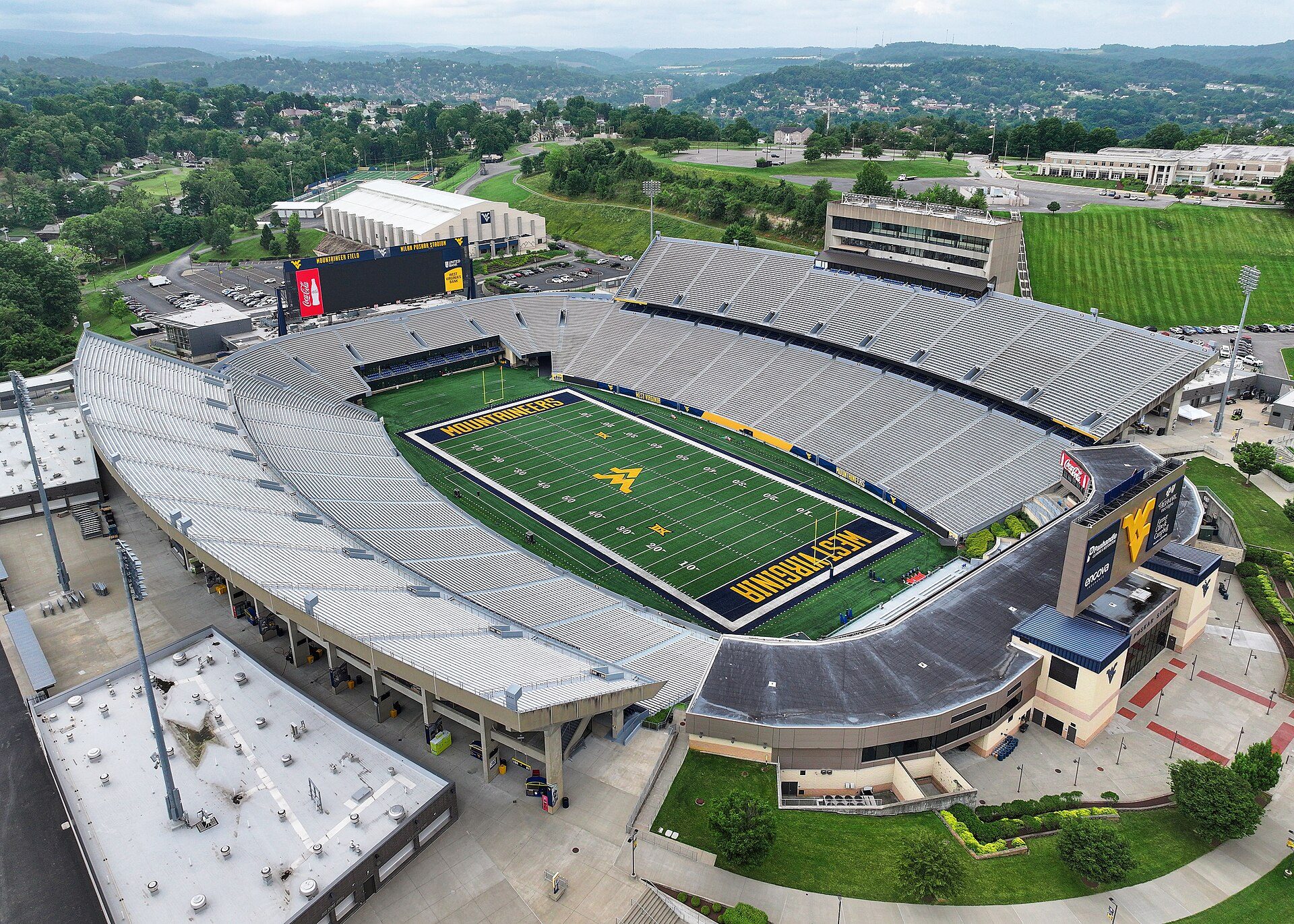
Milan Puskar Stadium sits in the hills of Morgantown, and the crowd singing Country Roads after a win is one of the great traditions in college football. Don Nehlen built the modern program in the 1980s and 1990s, Rich Rodriguez turned it into a national title contender in 2007, and Dana Holgorsen brought the Air Raid in the 2010s. Each era sent a new wave of players into the NFL, from linemen and linebackers to the speedy playmakers the program is best known for.
Play CollegeGuessr
Five NFL players every day. Name their college fast and clean for the best possible score.
Test Yourself on West Virginia Players
Reading about them is one thing. Naming them on sight is another. CollegeGuessr shows five NFL players a day and asks which college each came from. Answer fast for up to 200 points per player, then see how you stack up on the daily NFL trivia leaderboard.